
Army inducts anti-tank guided missiles along LoC to bolster defence


A total of 210 missiles along with 12 launchers were delivered to the Indian Army from Israel under a Rs 280 crore deal, as a part of its 'emergency purchase' mechanism. These anti-tank guided missiles and its launchers were inducted along the LoC...
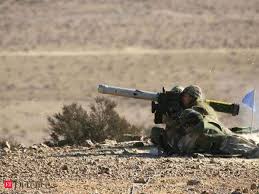


JAMMU: The Indian Army has inducted Israel-made anti-tank guided missiles (ATGMS) Spike along the LoC in northern command theatre in Jammu and Kashmir to bolster defence along the country's border with Pakistan.

Known as the "fire and forget" missiles, Spike ATGMs are portable by men and are powerful enough to destroy tanks and bust bunkers within four kilometers.

These anti-tank guided missiles and its launchers were inducted along the LoC in northern theatre from October 16-17 and are being used currently, Army sources told PTI.

A total of 210 missiles along with 12 launchers were delivered to Army from Israel under a Rs 280 crore deal, as a part of its 'emergency purchase' mechanism.

The much-needed deal was struck after the Pakistani army moved some of its troops to the border following the Indian Air Force's strike on terror camps in Balakot, deep inside Pakistan.
The "fire and forget" ATGMs have a strike range of up to four kilometers and can be used to destroy bunkers, shelters, launching pads and terrorist training camps close to the LoC, said sources.

In July this year, the Army had placed an order for procuring Israeli anti-tank Spike missiles, known for their "precision targeting", under emergency purchases to meet the operational preparedness, sources said.

The missiles can be deployed in both mountains and plains, said sources adding, they can be fired from different platforms, including vehicles, helicopters, ships and ground launchers.

Spike ATGMs are manufactured by Rafael Advanced Defence Systems of Israel.

Kalyani group and Rafael Advanced Defence Systems commissioned a Rs 70 crore anti-tank guided missile production facility here in India in August this year.

Kalyani Rafael Advanced Systems, the joint venture between the two with 51 per cent of its ownership with Kalyani group, would be the first private sector entity to manufacture such weapon systems in the country.

Comments

Popular posts from this blog

Top 10 Best Sainik Schools In India as per NDA Selection

In this article you will get to know about Best Sainik Schools in India, Best Sainik School of India and top 10 Sainik schools in India When India became independent, most of the officers in the defense at that time used to come from elite families. To rectify the regional and class imbalance amongst the Officer cadre of the India Military, V.K Krishna Menon came up with the idea of Sainik Schools. The idea was to prepare students for Entry in the NDA. In Sainik Schools, deserving students can get high-quality education irrespective of their income or class background. The mission of Sainik schools is to prepare the cadets academically, physically, and mentally to enter the portals of the NDA. Today there are 33 Sainik schools running and proposed for future covering all the states of the country. But it has always been a topic of discussion that which of these is the best Sainik School school in India. Why do children take admission in Sainik Schools?  So that they can become offi...

Explained: What is Army Aviation Corps, the youngest Corps of the Indian Army

A look at the Army Aviation Corps’ history and its relevance in modern day battlefields, including in Counter Insurgency and Counter Terrorism (CI-CT) operations. Representative Image The Army Aviation Corps (AAC), the youngest Corps of the Indian Army, celebrated its 35th Corps Day on November 1. We take a look at the arm that adds an air dimension to the Army’s capabilities, its history, and its relevance in modern day battlefields, including Counter Insurgency and Counter Terrorism (CI-CT) operations. The roots of Army Aviation Corps The origin of the AAC can be traced back to the raising of the Army Aviation wing of the Royal Air Force in India in 1942, and the subsequent formation of the first Indian Air Observation Post in August 1947. The Air Observation Post units primarily acted as artillery spotters – which are the elements that help the artillery in directing the fire and also giving air support to ground forces. In the wars of 1965 and 1971, the Air Observation Post helicop...

That time when India took half of Pakistan to make it pay for a motorcycle

In 1947, British officer Yahya Khan offered his colleague 1,000 rupees for his spiffy red motorcycle. His colleague, Sam Manekshaw, agreed. But before Khan could pay, he was off to what was going to become Pakistan. The British split its Indian colony, and things on the subcontinent have been pretty tense ever since. To top it all off, Yahya Khan didn't pay for the motorbike. But he would, even if it took almost 25 years. The Partition of India was much more than the splitting of the British Raj into two independent states. It was a catastrophic split that tore apart the country and created millions of refugees, cost millions of lives, and split the armed forces of the country in two, all based on religion. Violence erupted almost immediately between the two groups on such a large scale that much of it has never been forgotten or forgiven. Animosity continued between both sides for decades, and the two have fought war after war because of the myriad issues left unaddressed. By 1970...