China has funded 12.7 lakh Nepalese Rupees to a non-government organisation (NGO) based in Kathmandu, to carry out a study on the motivation behind Gorkha community members joining Indian Army.
Sources stated that in June first week, China's Ambassador to Nepal Hou Yanqi funded a Nepalese NGO, China Study Centre (CSC), to conduct a study on Nepalis being recruited in the Gorkha regiment of Indian Army.
A fund of 12.7 lakh Nepalese rupees was allocated by the Chinese Embassy for this task. There are seven Gorkha regiments in the Indian Army comprising 28,000 Nepali Citizens. The regiments have a total of 39 battalions. In total, there are 11 Gorkha regiments, out of which four went to the British Army after Independence.
India has 1st, 3rd, 4th, 5th, 8th, 9th, and 11th Gorkha regiments and the British Army has 2nd, 6th, 7th and 10th regiments. The Gorkhas were integrated with the Indian Forces on April 24, 1815.
The Gorkha community consists of mainly four different tribes - Khas (or Chetri), Gurung, Limbus, and Rais. The recruitment of Nepali Gorkhas into the Indian Army stems from an arrangement agreed to in 1947 between India, the UK and Nepal, known as the Tripartite Agreement.
But Nepal has now stated that this agreement is redundant. The assertion was made after Nepal Prime Minister K.P. Sharma Oli first raised the issue during his meeting with former UK Prime Minister Theresa May.
Find out what makes the Gorkhas the most feared regiment of the Indian Army.
 |
| Gorkha Regiment - Khukri inspection |
Sources stated that in June first week, China's Ambassador to Nepal Hou Yanqi funded a Nepalese NGO, China Study Centre (CSC), to conduct a study on Nepalis being recruited in the Gorkha regiment of Indian Army.
A fund of 12.7 lakh Nepalese rupees was allocated by the Chinese Embassy for this task. There are seven Gorkha regiments in the Indian Army comprising 28,000 Nepali Citizens. The regiments have a total of 39 battalions. In total, there are 11 Gorkha regiments, out of which four went to the British Army after Independence.
India has 1st, 3rd, 4th, 5th, 8th, 9th, and 11th Gorkha regiments and the British Army has 2nd, 6th, 7th and 10th regiments. The Gorkhas were integrated with the Indian Forces on April 24, 1815.
The Gorkha community consists of mainly four different tribes - Khas (or Chetri), Gurung, Limbus, and Rais. The recruitment of Nepali Gorkhas into the Indian Army stems from an arrangement agreed to in 1947 between India, the UK and Nepal, known as the Tripartite Agreement.
 |
| Gorkha Regiment drill |
But Nepal has now stated that this agreement is redundant. The assertion was made after Nepal Prime Minister K.P. Sharma Oli first raised the issue during his meeting with former UK Prime Minister Theresa May.
Find out what makes the Gorkhas the most feared regiment of the Indian Army.
17 Facts About The Gorkha Regiment
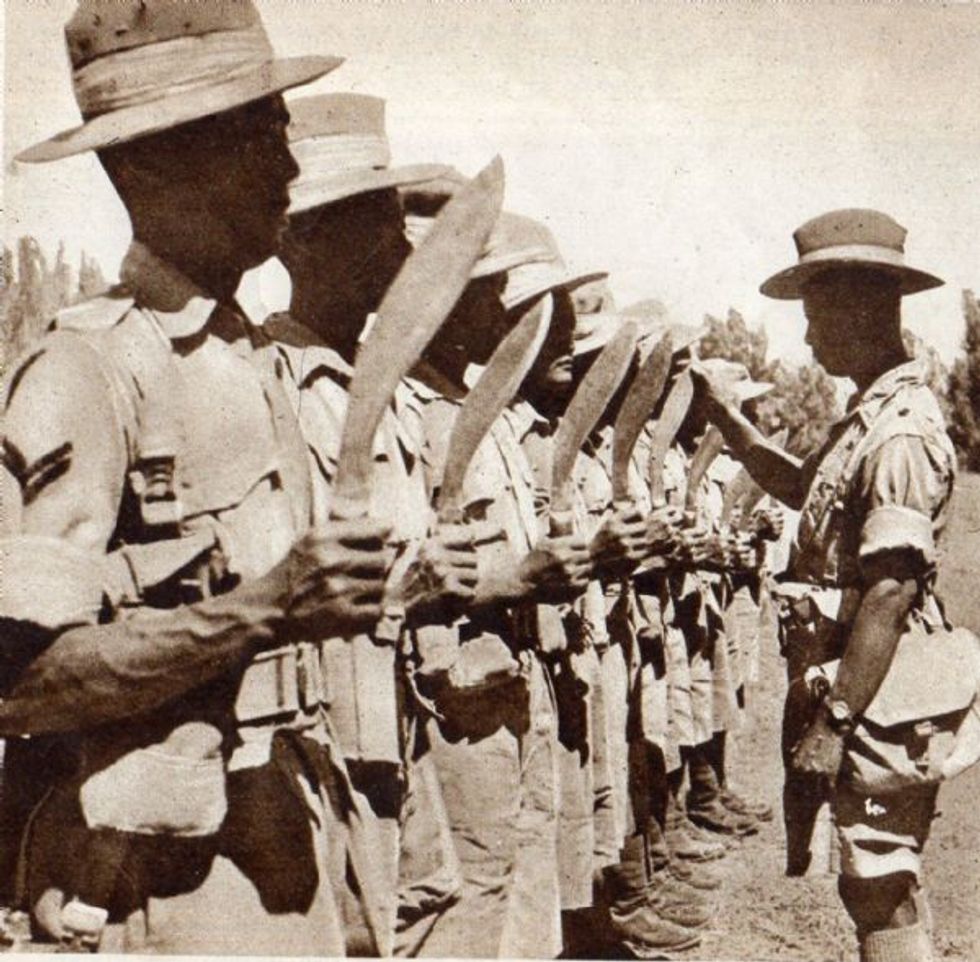 |
| A vintage photo of Gorkha Regiment - Khukri inspection |
- Contrary to popular belief that the British East India Company was the first to recruit Gorkhas as soldiers, Army officers contend it was, in fact, Maharaja Ranjit Singh who raised a battalion of Gorkhas to serve in the Sikh Army around 1809-1814
- There are about 32,000 Nepalese Gorkhas currently serving in the Indian Army's seven Gorkha Rifle regiments (1st, 3rd, 4th, 5th, 8th, 9th and 11th), each of which has five to six battalions (around 800 soldiers each).
- The 2nd, 6th, 7th and 10th regiments went to the British Army after Independence in 1947. These have now been consolidated into one Gorkha regiment in the British army.

Gorkha Regiment drill - Another regiment was raised by the Indian Army, the 11 GR, to accommodate the soldiers who refused to be transferred to the British Army.
- The current Chief of Defence Staff (CDS) General Bipin Rawat is from the Gorkha Rifles. In fact, several Army chiefs have been officers in on of the Gorkha regiments.
CDS General Bipin Rawat - The Gorkha Rifles war cry is "Jai Maha Kali, Aayo Gorkhali! (Hail Goddess Kali, the Gorkhas are here!)", or simply "Aayo Gorkhali Charge!"
- All the non-Gorkhas in the Gorkha Rifles have to learn Gorkhali/Nepali language so they can communicate with their regiments.
- The Gurkhas took part in the two world wars, the Falklands conflict and British operations in Bosnia, Kosovo, Afghanistan, East Timor and Sierra Leone, according to Reuters.
- The Gorkha Rifles regiments had a tradition of sacrificing a male buffalo on the festival of Dussehra. The defence ministry in 2015 put an end to that tradition.
- So impressed were the British by the fighting skills and valour of the Gorkha soldiers in the Anglo-Nepal War of 1814-16, that they were quick to integrate them in the British Indian Army.
- They weren’t raised as the Gorkha Regiment however. Instead it was called the Nasiri Regiment. The regiment was later renamed 1st King George’s Own Gurkha Rifles.
- The Gorkha units are some of the most decorated in the Army. They have played an important role in all the wars and have won Battle Honours in Uri sector in 1947-48, Ladakh in 1962, Jammu and Kashmir in 1965 and 1971. They were also a part of the Indian Peace Keeping Force in Sri Lanka.
- The Gorkha Regiments have been awarded 3 Param Vir Chakras, 33 Maha Vir Chakras, and 84 Vir Chakras during operations.
- The Gorkha Regiment has completed more than 200 years with the Indian Army.
- The Regimental Insignia of all the Gorkha Rifles Regiments consists of a pair of crossed Khukris. The Khukri is a traditional Nepalese knife with an 18-inch long blade which all Gorkha Rifles soldiers carry as a personal weapon. It is a weapon of which it was said if drawn in battle had to "taste blood", either of the enemy or of its owner, before being resheathed.
- The Gorkha Regiment also has a tradition of sacrificing a male buffalo on the festival of Dusshera. The head of the buffalo has to be severed in one clean sweep of the Khukri. Usually the youngest member of the unit gets the privilege.
- Field Marshal Manekshaw, who’s parent unit was 12th Frontier Force Regiment that moved to the Pakistani Army, became a part of the 8 GR. He would later become the Colonel of the regiment of the unit. He once famously said “If a man says he is not afraid of dying, he is either lying or is a Gorkha.”

Comments
Post a Comment